Monday, 11 November 2013

What does Home mean to you?

And yet, as his own death drew near, Sakyamuni turned again towards the north....“ Come Ananda, let us go to Kushinagar”. Like the rest of us, perhaps he longed for home  -  Matthiessen in The Snow Leopard.

Let’s go home! – Dr. Ryan in Gravity

What does home mean to people? 

Is it the house that one stays in or owns?
Is it the place where your family or parents are?
Is it the place where one grew up?
Or the place where your ancestors came from?   
Is it just being with the person you love?
Or is it just being yourself with your partner or your friends?
Is it a place where you feel you belong?
Or is it the feel of the air and the earth that is so familiar to you?

We humans are strange beings. At one hand we are forever trying to explore and reach the unknown and then again going further – from the continent of Africa and now to Mars and beyond. On the other hand, there is always an unrelenting need to find one’s roots, a place one can call home.

I have often wondered if the second generation of Tibetans in India feel the same sense of rootlessness that their parents must have felt in an alien land. What about the Bengali and other communities who were forced to leave Assam and Meghalaya even though they had lived there for generations....did they find their roots back in Bengal or do they still pine for the smell of the hills? Despite so many stories and movies, will we ever really understand what people must have felt when the two communities were suddenly uprooted during Partition? Does every Jew in the world feel the need to visit Israel, just so that they know it’s their home and a place which is supposed to be a safe haven for them always? If ever they find peace, will the people of Gaza strip and Palestine who have grown up in an era of strife feel that freedom and comfort to travel and venture out? How deep was the pain of Navratilova who had made America her home but could not stop her tears when the Czech national anthem was played?  

When people ask me where is home, I am often stumped. My connection with the state of my community or ancestors is very low because I have never lived there. Except for nostalgia and good memories of a carefree childhood, the place where I grew up has no charm left for me anymore. I do miss the autumn and winters of Delhi but it’s a city I will not like to go back to anytime soon. I have found my warm fuzzy corner in Mumbai but I still have to grow my roots here.

When I grow old and my parents are not there anymore, I do not know where home will be then. But like the Buddha, if there is any place that I would want to go back to at the end of my years, it will be to the high snow bound mountains up north.  It’s cold winds, the cerulean skies, warm afternoon sun and the towering snow peaks all around; that is what I want to feel and that is what I want to see when I finally close my eyes. At home, at peace.


Friday, 1 November 2013

Understanding the Other Side:

I recently met an academician and our conversation veered from Geology (her subject) to Climate Change.  She, like many geologists across the world vehemently disagrees about anthropogenic climate change or change in climate due to man-made reasons. This piqued my interest because for the first time I realised that in my eagerness to talk about environment, I had forgotten to look at the other side of the coin!

She insisted that the ‘issue’ of climate change as it stands in the global economic and political forums is a hoax / hogwash because all these so-called changes in climate discussed ad nauseam in media are just a part of Earth’s natural processes. She rattled off names of scientists, researchers, and agencies etc who have worked on this and though I had not heard of any of these names, I vigorously nodded my head just so that I didn't sound so ignorant.    

I asked her for some reading materials which she happily acquiesced to. What I read is just a tip of my ignorance iceberg but they are definitely very interesting; enough for me to want to know more and oh yes, debate!

In short, NIPCC (Nongovernmental International Panel on Climate Change) was formed to counter IPCC’s (International Panel on Climate Change) claims about Climate Change. According to HIPCC, IPCC is funded by governments through tax payers’ money and hence has vested interests. The scientists with IPCC usually move around in swanky hotels in exotic locations and use computer generated models to predict catastrophes which don’t have any scientific backing. HIPCC and other independent geologists have also alleged that IPCC has changed or ‘corrected’ data to prove future disaster scenarios and dramatic rise in sea levels. To every claim that IPCC has come out with, HIPCC has come out with a counter claim proving exactly the opposite. So as per HIPCC and many other geologists / scientists, there is no rise in sea levels or will be (infact it has dipped in some places), there are no glacial melts, no extreme weather patterns, no crop failures or ecosystem changes which cannot be explained as basic natural cause and effect.  This group believes that increase in CO2 in the atmosphere is infact good because it will help in regeneration of forests and produce better crop yields (to name a few). So, life is good as it is and we should continue in the same way.

Fair Enough!


Source: adaptationresourcekit.squarespace.com


Though I have hardly read or understood enough and I am Definitely not an expert on this subject, I am left wondering why so much of this debate is only centered around greenhouse gas emissions. Should it just be about CO2 emissions or about overall environmental degradation? Yes, Earth has a cyclic pattern of heating up and cooling down. When average temperature rose a 1000years back, it wouldn't have made much difference because they had more forest cover, lesser ‘emissions’ to counter the rise.  Now with most forest cover gone, polluted rivers, plastics galore, and dams blocking rivers etc, will not the natural change in Earth’s temperature affect many things?  And what vested interests would governments have in changing a perfectly established highly capital intensive economy to something which might not be so in future?

As for me, in the four decades of my nearly ignorant life, I have seen enough damage to nature to not get worried. It worries me that Mumbai’s balmy 30 degrees climate has changed to a hot and humid 36 degrees; that Delhi’s winter has shortened to a few weeks instead of months and that there are hardly any afternoon rainfall in Bangalore these days.

On that day however, despite being on either sides of the spectrum, we both agreed to one thing – that this (the debate on Climate Change) is just another Game!


*********************************************************************************
To read more on the other side of the debate check out http://www.climatechangedispatch.com/


Sunday, 13 October 2013

Stinking Earth:

Sitting outside in the balcony of a guest house overlooking the valley and snow peaks which were then hidden by clouds, my friend pointed to a small mud house in the distance. It was the only remnant of a time when the valley was filled with farms and beautiful village huts.  The valley and all the area around it is now covered by concrete constructions and garbage.  When my friend had first queried with the owner of the guest house on where to throw the garbage, she had matter-of-factly told her to throw it outside her balcony.  In the next few days, I noticed most guests living in the neighbouring guest houses dumping garbage and plastic bags into the valley and stream below. My friend walks a few kilometers to throw her garbage into a designated garbage dumper every few days.


Mud house in between concrete

This is how the present day Mcleodganj, Dharamshala and Dharamkot region in Himachal now looks. The quaintness and the beauty that I had found on my first visit to the same region way back in 2005 are long gone.  As tourists pour in every weekend changing the social fabric of the place with their rough behaviour and ‘eve-teasing’, the travelers have started moving further out changing the quaint villages into mushrooming concrete jungles with trails of garbage all around. The locals who have never known large sums of money get swayed easily and sell off their land. The money vanishes within years and most of them then have to migrate out in search of jobs or hard labour plunging their families into difficulties they had never anticipated.


Scenes of garbage all along Dharamshala and Mcleodganj

The vicious cycle continues and it doesn't have any immediate solutions. In the meanwhile, the beautiful valleys and quaint villages keep getting covered with plastic and garbage which neither the municipalities nor the local communities or the tourists want to take responsibility for.


*****************************************************************************

Photo credit: Zalina Gamat

Abhijit Patil, a photographer, is using his art project Sadakchhap to create awareness about the menace of garbage in the mountains. Apart from showcasing the work of local budding photographers in the region, he will also create an installation made out of garbage. To know more about the project, get onto the Sadakchhap Facebook page.

Didi Contractor, a well known architect, uses local materials, knowledge and labour to make modern houses in the mountains. These houses are made of mud, costs much less than concrete houses, is eco-friendly and also do not require regular maintenance.


In an interview with HarmonyIndia, Didi said, “I am not against money but valuing things by money is a terrible mistake. The most valuable things are those we cannot buy, like love and sunsets. We have betrayed our relationship with nature. We should be ashamed that we are not leaving behind a better world.” (source: www.yourstory.in)


Saturday, 10 August 2013

Why I will never work for Violence Against Women:

In early 2011, as part of my work, I went to Pune to document our partner’s work with survivors of violence primarily domestic. I spent the whole day with the lawyer activist discussing the topic and trying to understand its various aspects. I saw and heard the cases which had just come in while I sat there in the office. Then I went out to talk to a few survivors themselves and know of their stories.

At the end of the day, while waiting for a cool cab to take me back to Mumbai, I finally got some time to review what I had seen and heard throughout the day. And it was then that it hit me. I stood there clutching my stomach as wave after wave of nausea coursed through me.  I was suddenly desperate to come back to the warmth of my home. Next day I went to office and told my manager NEVER again to send me for work on this theme.

That one day in a tier one city made me realise a lot of things. That all this while I, like others, had happily chosen to ignore this issue as something which happened only in the lower income strata. That violence can take such ghastly forms and proportions that it becomes unbelievable. That we live in a society so SO sick, that it has begun to scare me.  That people, rather men, can go to any extent for greed and power....it doesn't matter if it’s your 70 years old mother, 12 years old daughter or a newly wedded wife.

Over the years I have come to question why we talk about violence as only a women’s issue. When the focus is just on the women as victims or survivors, the perpetrators or the men are relegated to the background and their behaviour accepted. It’s left to the women to survive and try and lead a next to normal life.

Well, I do not think it’s an issue related to women at all. For me, it’s an issue related more to the society in general and men in particular. Isn't it strange that in most of the cases of violence (in any form), the perpetrators are men? It’s the men who are violent not only against women, but they are violent against children and other men too. So, shouldn't we as a society start to see and accept the problem in its right perspective? And more importantly, shouldn't men start to introspect as to why is it that only they tend to behave like that? Women, who are survivors of abuse and violence even as a kid, do not grow up to become perpetrators themselves. The same sadly can’t be said about men.

Over the years, I have gained tremendous respect for all the women and men working tirelessly on this issue under so much of negativity and surrounded by so much of despair.  

The lawyer activist had told me that one learns to build a defense mechanism else they could be easily pulled down.   
   

As for me, I am just not brave enough. And for the sake of my emotional sanity, I prefer to stay away.
  

Sunday, 30 June 2013

Let My Himalayas Be:

I think I am a very bad person.

When the news of the Uttrakhand tragedy broke on Facebook, my instant comment on a friend’s post was “I am neither surprised nor sad". Over the days, with more stories surfacing on the massive scale of destruction and lives lost, not a single one could affect me greatly. Each time I read the news, a smug satisfaction filled me and I would silently say to myself; “Well done Nature, now they will understand why they shouldn’t mess up with you”.   

Last year in Oct, I had travelled through Rudraprayag and Chamoli to reach Lata village bordering the Nanda Devi Biosphere Reserve. The sheer mass of concrete all around, blasting of mountains for roads, hundreds of vehicles on roads, dust haze, plastic floating on the green rivers and construction of four dams in a 150km stretch had left me feeling devastated. (my earlier post on Uttrakhand)

I came back and spoke to a couple of NGOs, environmentalists and dug up stories in Down to Earth and what I found left me astounded, shattered and feeling utterly helpless.  Because it’s not just Uttrakhand which is leading the devastation, the entire Himalayan eco-system ranging from Himachal to Arunachal is at stake.

Information sourced from the citizens’ report - The Energy State and the Tragedy of its Rivers*

  • 200 tunnel-based hydroelectric power projects have been announced to achieve the target of generating 24,876 MW of electricity. The majority of these are to be built in Zone IV & V of this earthquake prone state where landslides and floods are very common. The 200 power projects envisage a construction of 700 km of tunnels that will be built through the eco-fragile mountains.
  •  Around 2 to 2.2 million people living in villages under which these tunnels pass are being affected. There was no Public Hearing before the construction of Singoli-Bhatwadi Hydroelectric Project (90 MW) started. The affected villages got to know only when they started cutting down their trees for the project. A 13 km long tunnel will be constructed for this project and it will run under 26 villages.
  • The tunnel of the Vishnuprayag Hydroelectric Project (400 MW) is 16 km long and extends between Lambagad and Chaain villages. Four tunnels of this project go from under Chaain village to the power house. In September/October 2007, unexpectedly, land started collapsing and sinking in and around this village.
  • During the construction of the tunnel for this project five natural water sources in the village of Chaain had dried up. A 1 km long irrigation channel that supplied water to the village has become redundant.

Information sourced from the report – Damming Northeast India **
  •  In a study in 2001, 168 hydro power projects were identified in the Brahmaputra basin with a total installed capacity of 63,328 MW. Till October 2010, the government of Arunachal Pradesh had already allotted 132 projects to companies in private and public sector for a total installed capacity of 40,140.5 MW. Around 120 of these involve agreement with private players accompanied by huge monetary advances.
  • Environmental Impact Assessment (EIAs) necessary to approve any power projects have been a farce in India and so it is in the case of NE.  For example - the EIA for the 1,000 MW Siyom project lists 5 bird species in an area which has over 300 species and even in this short list has one which is non-existent; the EIA for the 600 MW Kameng project reclassifies carnivores such as the red panda, pangolins and porcupines as herbivores; the EIA for the 2,000 MW Lower Subansiri lists 55 species of fish in a river which has at least 156 species and reports an area called the ‘Arctic’ in the Eastern Himalayas.
  • Virtually all available arable land in the affected Siang valley will be submerged by the 2700MW Lower Siang project.
  • States like Arunachal Pradesh and Sikkim are home to small populations of culturally sensitive indigenous communities. The entire population of Idu Mishmi tribe in Dibang valley is 9500 and their displacement by 17 projects has been termed as ‘small’. Moreover, the projects will bring in more than 150,000 labourers from outside for a long time which will completely change the demographic and socio-cultural identity of the region.


Damming all the rivers in the bio-diversity hotspot of Arunachal

Soon Teesta and Rangeet will stop being free-flowing rivers

Information sourced from Down to Earth ***
  • A study of 132 dams out of 292 that were proposed or were under construction in 2005, showed that there would be one reservoir every 3000 sqkm which is 62 times the global dam density.
  • 90% of the river valleys and 25% of dense forests in the Indian Himalayas would be affected. Over 54,117 hectares of forests would get submerged while 114,361 hectares would be damaged by dam related activities.
  • 88% of the projects fall in zones rich in plant, bird, fish and butterfly species.

It surprises me immensely that nobody has found it imperative to do a cumulative impact study of more than 600 dams and other projects on the Himalayan eco-system. I am even more surprised that by virtue of being in the Himalayas, these States which should be much more responsible to its people, the rest of the country and the world are hell bent on destroying the future. When will somebody, anybody wake up from slumber and realize that the Himalayas are special, an absolute necessity for our survival and that we need to treat them, its lovely communities and its eco-system differently?

Just when will they let my beloved mountains be before it’s all too late?

*********************************************************************************
Sources:

The Energy State and the Tragedy of its Rivers - Suresh Bhai; Raksha Sutra Andolan, Jal Sanskriti Manch, Nadi Bachao Andolan Uttarkashi, Himalaya Seva Sangh; Uttarkashi, 2009.

 Damming Northeast India – Joint report by Neeraj Vagholikar (Kalpavriksh), Partha J. Das (Aaryanak) and Action Aid India, 2010.

Himalayan Destruction – Down to Earth, January 2013

Maps – Sanctuary Asia, maps adapted from the Department of Hydropower Sikkim and Arunachal Pradesh


Sunday, 2 June 2013

A letter to my Earth:

My beloved Earth,

If you ask me when was it that I fell in love with you, I will not be able to pinpoint a time. If you ask me when was it that I became aware of you, I will not be able to pinpoint that time either. Because if I look back at my life and at my earliest memories, I can tell you that I was born loving you and that I was aware of you always.

My first memories of myself are that of a two year old tottering around the orchard surrounding the house. I remember being fascinated by the huge mango and custard apples trees laden with fruits ready to be plucked. I grew up on stories my father used to tell my sister and me while I sat on his lap - of Phantom and Tarzan. I used to listen to the stories captivated not because of the strength and valour of the super heroes but because they lived in the jungles with animals as friends. I grew up wishing for a life just like that....deep in the jungles with trees and animals as friends.

Some of the happiest moments in my childhood were the times I spent with you.....shaking off the dew collected at the base of the yellow and orange cannas, searching for spiders under the flowers, climbing trees, collecting beautiful coloured stones and pebbles from the sand mounds, observing the caterpillar weaving a cocoon, running out to feel the strength of the wind during storms, sitting at the window and getting drenched by the rain.

Oh, how I still wish for that life closer to you....of walking through a field of swaying golden grass, feeling the mellow sun on my skin and the breeze in my hair, of the blue mountains in the distance and the blue sky above....feeling free.

But all I can see now is the spread of concrete and commodities with no regards to your very existence. I can see your beautiful mountains, rivers, forests shrinking, drying up....like a poisonous scab slowly seeping the life blood out of you. How did it ever come to this in so short a time span? I am scared to look into the future, I am scared for you. And every time I think of the future, a strange claustrophobia grips me. Because I know that soon enough, there will be no real escape left.

How I wish I could apologise to you on behalf of my fellow humans and make it all go away. How I wish I could shake each one of them and tell them to stop before it’s too late. I don’t know what the future holds but all I know is that I just can’t let go of you.

And I only hope that, despite whatever happens to you, you will not give up and let go of me.

Yours ever,

A weary wayfarer seeking sanctuary


Sunday, 19 May 2013

Imprints of a Journey:

I travel for the journey, the never ending road that becomes your home, the beauty of experiencing the ever changing scenery, culture and people, the ecstasy of freedom...of leaving everything behind and the longing to keep journeying further and never return. Almost all the places I have travelled to have left some imprints with me like Corbett NP where I realised for the first time that all I wanted to do in life was to keep travelling, the mysterious pull of the ruins at Nalanda, the quaint tiny station of Rameshwaram which sprang to life as the only train of the day pulled in ever so slowly, an evening at the beautiful Brihadeshwara temple of Tanjore where life didn’t seem to have changed much for centuries, the strong energy that one could still feel amongst the ruins of Hampi, the torrential rain and the deep dark forest of Binsar, the walk on the empty road to Borra Caves where the echo of a train whistle filled up the entire valley.

But then, there are also places which have left a deep impact on me and these are the places where I would want to go back again and again irrespective of the pleasures of a journey. 


Ladakh:


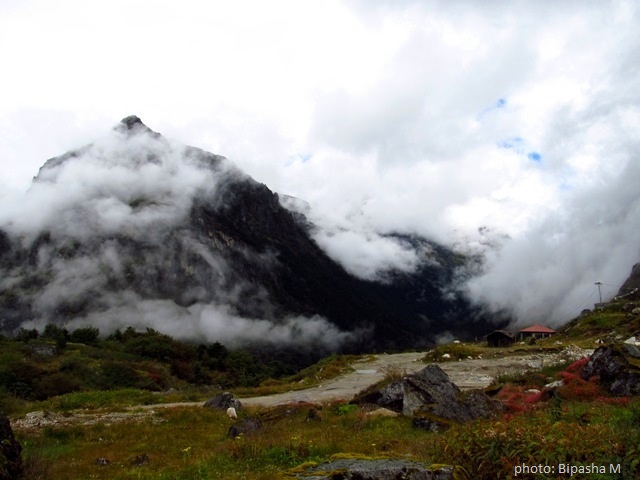
A gruelling trek from dry Kibber across an 18500ft pass to Rupshu Valley in Ladakh threw us right into the heart of raw nature. All around us were the stark mountains, harsh weather and numerous ‘mis’ adventures. On nights when I wouldn’t be dead tired from the day’s walk, I would remain outside after everybody had slept off. On those nights, despite bone numbing cold wind, I would sit mesmerised by the trillions of stars in the sky feeling utterly tiny in the vastness of universe. For me that defined real life, right there in the middle of those mountains and not what we lead in the cities. On the penultimate day, when we were sitting atop the Leh Palace gazing across the mountains, a sublime Buddhist chant floated up from the town below. Coming back to Delhi and resuming daily life was traumatic that year for me.        


Arunachal:


A description for this place eludes me. It’s complex in its natural beauty and simplicity. The same can be said for its people. This is the only place in my travels across the country where I, as a woman, felt totally free and safe. This is the place where I could run (or walk) around in wild abandon (mentally) whopping with joy.  In Itanagar, you could sense the frustration amongst the youth for not being treated as Indians by others; in Tawang, people were scared and preparing for a time when it might be taken over by China. Though tribal identities are very strong, people here are one of the friendliest if you win their trust. My friend and I had a chance meeting with Tapi Mra (an Everester) who went out of his way to ensure we got the right seats in the right vehicle to our next destination.  


Chhattisgarh:


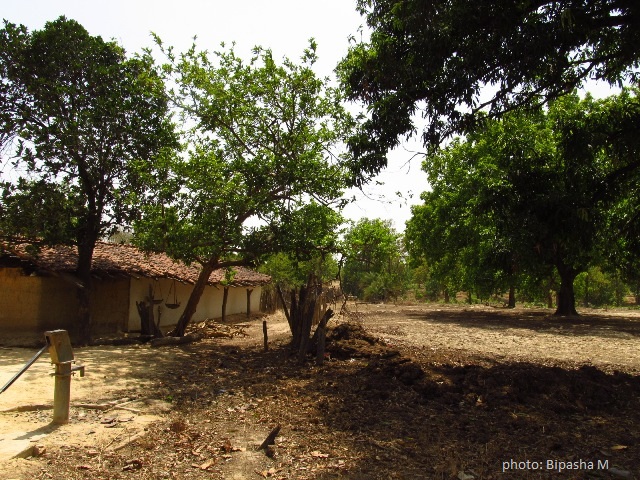
Rewind to a time, to a rural India of five or six decades back. That is the innocence one finds in Chhattisgarh along with high levels of poverty. But what struck me about the place was the presence of a primeval energy. It felt as if nature thrived for centuries undisturbed by humans – until now. Trees are massive here growing and spreading out as far as possible with each and every tree having a distinct character. And deep inside the forests, if you whisper to the trees....they whisper back to you. All you have to do is listen.    


Monsoon in the Konkan and Sahyadri:


Every year, the transformation with the onset of rains leaves me astounded. I love the rains anywhere but in the Western Ghats, it turns magical. The dark grey clouds rolling in from the tumultuous grey sea turns everything into a carpet of green. The consistent drizzle that characterised monsoon in the east during my childhood is nowhere close to the heavy downpours of the west. Like the village communities who go about their daily lives with a conical bamboo and plastic cover on their heads, we also have learnt to negotiate the rains here. However what becomes difficult to negotiate during these days is the call of far-away lands and the pull of the churning dark clouds.