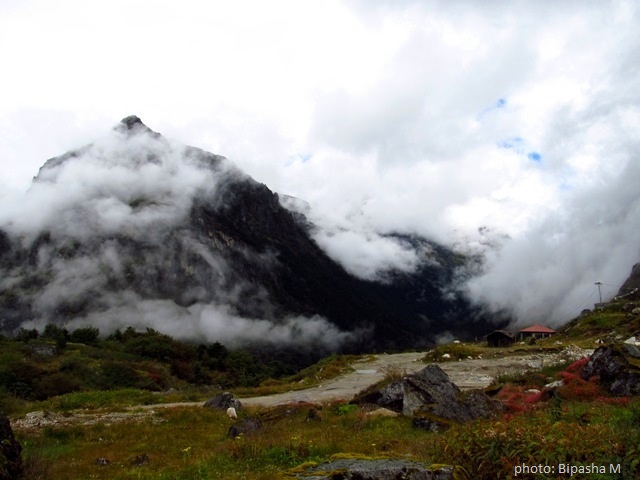
I think I am a very bad person.
When the news of the Uttrakhand tragedy
broke on Facebook, my instant comment on a friend’s post was “I am neither
surprised nor sad". Over the days, with more stories surfacing on the massive
scale of destruction and lives lost, not a single one could affect me greatly.
Each time I read the news, a smug satisfaction filled me and I would silently
say to myself; “Well done Nature, now they will understand why they shouldn’t
mess up with you”.
Last year in Oct, I had travelled through
Rudraprayag and Chamoli to reach Lata village bordering the Nanda Devi
Biosphere Reserve. The sheer mass of concrete all around, blasting of mountains
for roads, hundreds of vehicles on
roads, dust haze, plastic floating on the green rivers and construction of four
dams in a 150km stretch had left me feeling devastated. (my earlier post on Uttrakhand)
I came back and spoke to a couple of NGOs,
environmentalists and dug up stories in Down to Earth and what I found left me
astounded, shattered and feeling utterly helpless. Because it’s not just Uttrakhand which is
leading the devastation, the entire Himalayan eco-system ranging from Himachal
to Arunachal is at stake.
Information
sourced from the citizens’ report - The Energy State and the Tragedy of its
Rivers*
- 200 tunnel-based
hydroelectric power projects have
been announced to achieve the target of generating 24,876 MW of electricity. The majority of these are to be built in Zone IV & V of this
earthquake prone state where landslides and floods are very common. The 200 power
projects envisage a construction of 700
km of tunnels that will be built through the eco-fragile mountains.
- Around 2 to 2.2 million people living
in villages under which these tunnels pass are being affected. There was no Public Hearing before the
construction of Singoli-Bhatwadi Hydroelectric Project (90 MW) started. The affected
villages got to know only when they started cutting
down their trees for the project. A 13 km long
tunnel will be constructed for this project and it will run under 26 villages.
- The tunnel of the Vishnuprayag
Hydroelectric Project (400 MW) is 16 km long and extends between Lambagad and
Chaain villages. Four tunnels of this project go from under Chaain village to
the power house. In September/October 2007, unexpectedly, land started
collapsing and sinking in and around this village.
- During the construction of the
tunnel for this project five natural water sources in the village of Chaain had dried up. A 1 km
long irrigation channel that supplied water to the village has become redundant.
Information
sourced from the report – Damming Northeast India **
- In a study in 2001, 168 hydro
power projects were identified in the Brahmaputra basin with a total installed capacity of 63,328 MW. Till
October 2010, the government of Arunachal Pradesh had already allotted 132
projects to companies in private and public sector for a total installed
capacity of 40,140.5 MW. Around 120 of these involve agreement with private
players accompanied by huge monetary advances.
- Environmental Impact Assessment
(EIAs) necessary to approve any power projects have been a farce in India and
so it is in the case of NE. For example
- the EIA for the 1,000 MW Siyom project lists 5 bird species in an area which
has over 300 species and even in this short list has one which is non-existent;
the EIA for the 600 MW Kameng project reclassifies carnivores such as the red
panda, pangolins and porcupines as herbivores; the EIA for the 2,000 MW Lower
Subansiri lists 55 species of fish in a river which has at least 156 species and
reports an area called the ‘Arctic’ in the Eastern Himalayas.
- Virtually all available arable
land in the affected Siang valley will be submerged by the 2700MW Lower Siang
project.
- States like Arunachal Pradesh
and Sikkim are home to small populations of culturally sensitive indigenous communities.
The entire population of Idu Mishmi tribe in Dibang valley is 9500 and their
displacement by 17 projects has been termed as ‘small’. Moreover, the projects
will bring in more than 150,000 labourers from outside for a long time which
will completely change the demographic and socio-cultural identity of the
region.
 |
| Damming all the rivers in the bio-diversity hotspot of Arunachal |
 |
| Soon Teesta and Rangeet will stop being free-flowing rivers |
Information
sourced from Down to Earth ***
- A study of 132 dams out of 292
that were proposed or were under construction in 2005, showed that there would
be one reservoir every 3000 sqkm which is 62
times the global dam density.
- 90% of the river valleys and 25%
of dense forests in the Indian Himalayas would be affected. Over 54,117
hectares of forests would get submerged while 114,361 hectares would be damaged
by dam related activities.
- 88% of the projects fall in
zones rich in plant, bird, fish and butterfly species.
It surprises me immensely that nobody has
found it imperative to do a cumulative impact study of more than 600 dams and other
projects on the Himalayan eco-system. I am even more surprised that by virtue
of being in the Himalayas, these States which should be much more responsible
to its people, the rest of the country and the world are hell bent on
destroying the future. When will somebody, anybody wake up from slumber and
realize that the Himalayas are special, an absolute necessity for our survival
and that we need to treat them, its lovely communities and its eco-system
differently?
Just when will they let my beloved mountains
be before it’s all too late?
*********************************************************************************
Sources:
The
Energy State and the Tragedy of its Rivers - Suresh Bhai; Raksha Sutra Andolan,
Jal Sanskriti Manch, Nadi Bachao Andolan Uttarkashi, Himalaya Seva Sangh;
Uttarkashi, 2009.
Damming Northeast India – Joint report by Neeraj Vagholikar (Kalpavriksh), Partha J. Das
(Aaryanak) and Action Aid India, 2010.
Himalayan
Destruction – Down to Earth, January 2013
Maps
– Sanctuary Asia, maps adapted from the Department
of Hydropower Sikkim and Arunachal Pradesh


.jpg)
.jpg)
.jpg)