Tuesday, 24 June 2014

A conversation with a 17-year old:


I was traveling from Hazaribagh to Ranchi. Over the years, Jharkhand has changed considerably. In its 14 years of existence, there has been as many changes in government putting a big question mark on stability, law and order and governance. Identity, political awareness, political ideologies and a sense of distrust for anybody who looked like an outsider (especially from neighbouring Bihar) seem to have put multiple layers in the way society conducted itself. I got the sense that nothing could be taken at face value and you had to read a lot between the lines.

I was assigned a driver who looked barely sixteen. When I questioned his age, his employer insisted and with conviction that he was 28 years old. I acquiesced. A beautiful highway made by razing thousands of trees and an entire hillside; a conversation with this interesting driver helped me keep my mind from mulling unnecessarily over this fact.

A few excerpts (all happened in Hindi):

Me: Did you study?
Chotu: I am giving my inter (mediate)
Me: Aha, so you ARE 16!
Chotu: (smiling) No, I am 17. My driver’s license says I am 21. You want to see?

****************************************************************************

Chotu: Didi, are you married? (national obsession at play yet again)
Me: No
Chotu: What is your age?
Me: What is your guess?
Chotu: I can say only approximately. Hmmm…24?
Me: (blessing him in my mind) I am 30. (I hear a gasp and I quickly rephrase) I haven’t reached 30 yet. (I wondered how he would react if I told him my correct age)
Chotu: When are you planning to get married? Half of your life is already gone!
Me: I haven’t thought about marriage. Do you think marriage is necessary? What if I decide never to get married?
Chotu: (clearly alarmed) No, no. You must marry. Who will carry forward your lineage? Who will take care of you when you grow old?
Me: What is the guarantee that my children will look after me in old age?
Chotu: See, if you have a son, being a boy I can tell you that he won’t look after you. If you have a daughter, she will definitely take care of you. Don’t you look after your parents?

****************************************************************************

Me: What if you like a girl, will you marry her?
Chotu: Didi, we have many issues. The girl has to be of our caste and then everybody expects the girl's parents to give dowry. I will get a minimum of 5lakhs for the work I do now.
Me: Will you take dowry?
Chotu: This year, a man came with an offer of marriage to his daughter and said he will give me 6lakhs. I told him to give me 3lakhs if he wants to but let me wait for a year.
Me: Would you meet the girl first?
Chotu: Yes, nowadays 95% of people do ‘mohabbat’. I would like to know her story. If she tells me honestly, I will accept her. If I find out later, I will tell her to leave.
Me: What about you? Will you tell her your story?
Chotu: Yes of course, you cannot build a life together on lies.

***************************************************************************

Me: What do your parents do?
Chotu: We used to be very poor and they used to work very hard for us. Now I don’t let them work. I have been working since I was 10 years old. After this job as a driver, I earn enough money to let them rest.
Me: What about your brothers, do they help?
Chotu: I can’t say about them. All I know is that I will always take care of my parents, even if my brothers get married and go away. Women tend to break up families because they keep thinking unnecessarily over things in their head and we men tend to listen and forget.
Me: Really?
Chotu: Only women can make a home and also break a home. Didi, when you get married, please do not fight ever!
Me: Ok Chotu, I promise to get married and never ever fight!  


Saturday, 10 May 2014

The Deep Chasm:


Social Sector: For a sector which prides itself in understanding the real issues of real or ‘unprivileged’ aspects of India, they seem to completely lack an understanding of the other side of ‘developing’ India. They are quick to judge when it comes to anything or anyone related to corporate India, mostly on the basis of their ideology or the lack thereof (anti-secular, anti-reservation, sexist, communal, capitalist etc). Somewhere I get the feeling that they do not want to understand either. As per the sector’s ideology, they are morally superior because they are trying to resolve issues affecting the society while the other side is not. Ooops! Did I say superior? No, here everything is about equality. Right?

“Corporate India / Middle class India is apathetic. They do not want to know the social issues or be a part.” Well, I have not seen any real effort at engaging or dialouging with the corporate sector or the middle class by NGOs to make them feel included. The importance of Corporate India or the middle class is being felt only when international aid has dried up and there is a desperate need to raise funds from within the country.
   
“Capitalism or anything related is evil, it perpetrates discrimination and promotes inequality.” However, this has not stopped anybody from shopping at Marks and Spencer or trying out new gadgets like the tablet or Samsung phones. In case people haven’t realised, these all are products of Capitalism itself! And what many have failed to observe is that freeing up the market in the 90s gave a lot of people, especially from tier II and III cities, many opportunities to step out and fulfill their aspirations. Call it the McDonalds effect but social and economic changes especially for women across the country have been much faster due to it than any social movements.


(source: www.examiner.com)


(source: www.prideinmadness.wordpress.com)

Corporate Sector: Theirs is a happy bubble of high aspirations and even higher material needs. To them, the answer to most issues, even social, is ‘development’ or economic growth as this year’s Lok Sabha Election has shown. They firmly believe that the ‘Trickle Down Effect’ will reach the remotest corners of our country eventually and root out all problems along with it. All the hard earned monies that we give as tax are anyway going to our poorer cousins in the villages as ‘free’ or subsidized sops and schemes. Why do they need more? A mere mention of inequality or issues faced by communities at the village level or our poorer counterparts in the cities and one is labeled as Marxist, jholachaap, anti-development etc.

NGOs are looked upon suspiciously as all of the above, cogs in the wheel of policy changes, corrupt with either money going in their own pockets or wasting it on unnecessary foreign trips and high salaries. A friend once said when I asked him about philanthropy: “I would rather financially support people I know who need it and know for sure that my money was utilized well rather than donate to an NGO and not know where it went.”          


Ours is a complicated country/society with multiple layers to each problem. Here’s a simple example - Computer literacy is the way to go no doubt and by donating a computer to a school in a village, you feel you are contributing to educating these children. But if the village school does not have expertise to handle a computer or maintain it or if there is hardly any electricity in the village for it to work, will your contribution make any sense? If girls do not get to study, how does it really help in the longer run? Add to this aspects of caste and you will find that in the end, your computer is lying unused in its corner.

Sitting at extreme ends of different ideologies and style of working and looking suspiciously at the other will help nobody. Just as there are corrupt companies, there are corrupt NGOs. Just as there are good companies, there are NGOs and activists doing great work. Just as Capitalism has some good points, Socialism also has some valid aspects. Without effort and dialogue, the existing chasm in thinking and work will never be bridged.

And the village folks will not be the sole sufferers but all of us because like it or not, we and our issues at different levels are all connected.


Friday, 21 March 2014

Casting Away the Caste?

Late 80s – Bihar: There was an ongoing rate list for dowry as per the jobs held and salaries earned. I remember that lowest in the rate list was that of a bank PO. The rate then was a whooping Rs.7 lakhs, unthinkable at that time. Of course if you belonged to a higher caste, you could attach a premium and nobody questioned.

2004 – South India: The concept of Indians backpacking was not really known then; so my travel partner and I were often mistaken to be foreigners. The first question people asked us after clarifying that we were Indians was, “What is your caste?”. We were accorded quick and good service because my travel partner was a Brahmin. Naturally, we took advantage of it.   

2009 – Mumbai: An employee of a well known education NGO got super excited when she found out that my colleague is married to a Brahmin. She asked me enthusiastically if I was a Brahmin too.

2011 – West Rajasthan: We travelled to a village on work where we had lunch in the house of an adivasi family (one of the best meals I have had so far but that’s a different story). We invited our Muslim driver to join us but he consistently refused saying he already had his meal. Later we realised that he didn’t want to have food in an adivasi home.

Village elders who usually form the Jati or Caste Panchayats (in Rajasthan). 


2011 – Jodhpur: We had stopped for food at a roadside dhaba run by a Rajput, who told us with some pride in his voice that all people including dalits and adivasis are welcome to eat at his Dhaba. A bit later he adds that he however will never eat at a dhaba run by an adivasi or a dalit.

 2011 – Melghat: A tribal village in a forest had been assigned an Aanganwadi worker who threw her weight around because she belonged to a ‘higher’ caste. The result was that none of the families sent their children to the Aanganwadi resulting in waste of food every day.

2012 – Bhopal: A friend has a neighbour who belongs to the Scheduled Tribes. She asked my friend if her domestic help could also work for her. When my friend approached the help with the request, she flatly refused. The maid, also belonging to a Scheduled Tribe told my friend that she can’t work for the family because they belonged to a lower stratum than her.

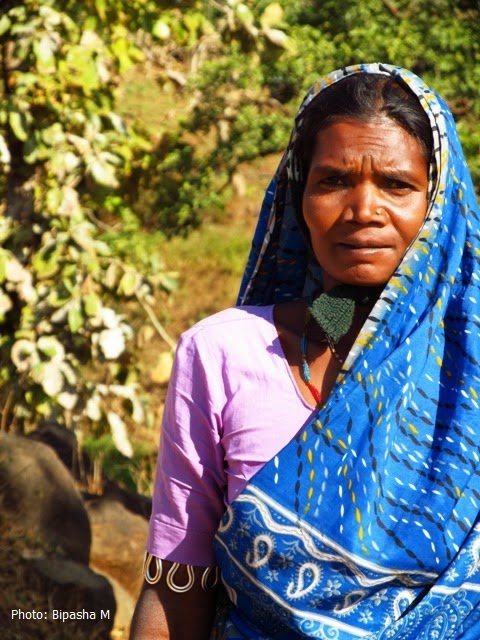
An adivasi woman from a forest village in Maharashtra

2013 – Gadchiroli: Aanganwadi worker approaches me and asks, “Madam, Aapka surname?” (to figure out my community and caste). I tell her only my first name instead.

2013 – Delhi: An employee of a rights based organisation is heard asking another colleague her caste.

2014 – Pune: A well educated, professionally successful girl works in one of the best consultancy firms. She is 35 and single. Despite her background she has not been able to find a match because she belongs to a Scheduled Tribe and nobody from the ‘higher’ castes wants to marry an ST (as told to her). 
 
Across India: Areas in most villages are segregated as per community and caste. Due to reservation, many villages now have SC / Dalit sarpanches but they are treated just as nominal heads. The Up-Sarpanch from a higher caste holds the main power and people listen to him. If a Sarpanch is a woman from a lower caste, then she doesn’t have much of a chance of being heard at all.


Its a power game mostly – this desperate need to somehow feel superior in the absence of any other way to prove their superiority. Proving that you are better than others through deeds and actions is hard work and also subjective, hence its so much easier to fall back on your superiority by birth. Power comes easy.

Ambedkar was as usual right, social reforms are necessary if the country has to progress on all fronts. Abolition of caste so far has been neatly done on paper. The politics now behind the caste system (despite the best intentions of affirmative action) will ensure that it remains deeply entrenched in our society. Even after so many years of actually seeing and experiencing the fallout of some decisions by our founding leaders, we as a nation do not have the guts to debate again on this. Liberty, Equality and Fraternity like Secular are just mere words without meaning in our Constitution.


And since we do not have the ability to understand and follow the essence of our Constitution, we will continue to remain Un-Indians. 

_____________________________________________________________________

Annihilation of Caste: An interesting read, more in the perspective of how Gandhi defended the caste and varna system.


Thursday, 20 February 2014

Marriage, Feminism and Other Stories:

The question invariably creeps up. Women are more direct, while men try not to be direct. But ask all will once they get comfortable. And why not, since concern about other people’s marriage or marital status remains a national obsession.
   
Like my alteration tailor who often chats up with me.
Tailor: Aapke ghar mein kaun kaun hain?
When I tell him about my family, he asks: Aur Bhaiyya?
Bhaiyya here means husband and not brother, he clarifies when I looked confused.

Like the BCom pass farmer in Gadchiroli.

Farmer: Aapka ghar kahan hain?
Me: Mumbai
Farmer: Aap kahan ke ho?
And then he starts listing out the states in order to guess. When I tell him where my parents are staying, he finally talks straight.
Farmer: Ghar ka matlab, aapke husband kahan hain?

______________________________________________________________________

Though it’s a common refrain among married women in urban areas, lately I am beginning to hear the same from some rural pockets too.

After the day’s work, I was sipping ‘lal chai’ with Pooja, a young mother and her maternal aunt Shilpa in a village in Gadchiroli. The inevitable question came up.

Pooja: Didi, aapki shaadi ho chuki? (are you married?)
Me: No, not yet.
Pooja and Shilpa together: Didi, don’t get married. There is nothing in marriage. You are good being single.
Me (surprised and super curious): Why do you say so?
Pooja: In a marriage you can’t be your own, you can’t do anything for yourself. You only have to listen to others.
Shilpa: After marriage, I have always been stressed. About my children, my life. Look at me, I am 35 and marriage has made me lose my health and beauty. I wanted to do so many things, study and I have not been able to do anything.

Shilpa was a natural leader commanding attention the moment she spoke and bristling with curiosity. She had the restless energy of a person caged wanting to break free. Pooja on the other hand was bursting with a new found energy, ready to do more than just sit around the house. I felt sad and happy at the same time. Happy that there are women who are beginning to think differently; sad because so many lives like Shilpa’s are just dying a restless death.

_______________________________________________________________________

Marriage is an institution created and perpetrated by patriarchy – so says the feminists but that has not stopped many of them from going ahead and getting married anyway. Some have done it the traditional way, some have retained their maiden names, some call each other partners instead of husband and wife while some just live together.   

In the urban areas, this institution or rather the idea of relationship is changing. Whether its distrust, ego, one- upmanship, space, equality, boredom or something else, relationships have altered dramatically. Like a fast changing society, people are also not sure what they should hold true or important.

The ancient Chinese philosophy of Yin and Yang carries a universal truth, interpretable across all areas of life but more so in relationships. High cannot exist without the low, light cannot exist without the dark, man cannot exist without woman or vice versa. What is lacking in one, the other fulfils. Different yet complimentary and coming together to form a whole.

In an era where the self rules, this concept perhaps is too difficult for people to understand.

Monday, 6 January 2014

Long Live the Idea that is India:

For the first time I felt free, truly free. I wasn’t looking over my shoulder constantly to see who was coming or keep my antennas up even a tiny bit. I rode my cycle at a leisurely pace just like the locals, dreaming along the way with no care or concern even for the traffic. No, this wasn’t anywhere in India, but in another developing country, Vietnam.  Everybody cycles there, so cyclists usually get the right of way.  But that’s not the point; the point is that this simple experience hit me hard. What I have always craved for in my own country, I got it elsewhere. It hit me hard because of the fact that I will never get it here, in my own country. This ridiculous sense of Freedom.

In the course of my limited travel within Vietnam, I felt that this very young country (it’s just 38years since the war ended) has moved way ahead of India – in terms of infrastructure, amenities, lifestyle, discipline and attitude. So what is it that makes us the way we are – a poverty stricken, chaotic, highly patriarchal, corruption ridden country? Just as I was almost ready to drown in hopelessness, my country turned the table and surprised all of us yet again.   

The Delhi elections and its eventual outcome, a political thriller of sorts, just showed the world how a true democracy can function and just how powerful a true democracy can be. For people like us, this gave us a much needed sense of hope and a momentum to keep pushing for all the changes in the system in a democratic way.

Infact, if I really want to see it, there’s a lot about this country that keep my hopes up. Where else would you find a country where a gruesome incident (amongst many others) brought an entire society to look deep within itself, question its deep seated traditions and force lawmakers to quickly amend archaic laws? Where else would you find this freedom of expression across media without the threat of a clamp down? Where else would you have such a strong human rights platform, despite some horrible mistakes like Section 377? Where else would you have so many good government schemes for its communities, even though most are on just paper? Where else would you have a limited but immensely strong network of environmentally aware citizens, when around the world most forests and rivers have run silent? Where else would you have highly successful space program at such a low cost? Where else would you have a country which can stand the might of international pharma companies because it believes in providing cheap basic medicines to all? Where else can you find dolphins being recognised as non-human persons with their own rights?

I might not be able to cycle so freely in this country in my lifetime, but I definitely want our next generation to find that freedom someday in future and without our poverty stricken, corruption ridden, patriarchal and chaotic society.   

And now I have begun to believe that the more I dislike my country, the more I fall in love with the idea that is India.

Long live the idea of India. 
           
*************************************************************************
Watch this very interesting video of how dolphins have been helping fishermen for the past 150 years: Dolphins help Fishermen

Monday, 11 November 2013

What does Home mean to you?

And yet, as his own death drew near, Sakyamuni turned again towards the north....“ Come Ananda, let us go to Kushinagar”. Like the rest of us, perhaps he longed for home  -  Matthiessen in The Snow Leopard.

Let’s go home! – Dr. Ryan in Gravity

What does home mean to people? 

Is it the house that one stays in or owns?
Is it the place where your family or parents are?
Is it the place where one grew up?
Or the place where your ancestors came from?   
Is it just being with the person you love?
Or is it just being yourself with your partner or your friends?
Is it a place where you feel you belong?
Or is it the feel of the air and the earth that is so familiar to you?

We humans are strange beings. At one hand we are forever trying to explore and reach the unknown and then again going further – from the continent of Africa and now to Mars and beyond. On the other hand, there is always an unrelenting need to find one’s roots, a place one can call home.

I have often wondered if the second generation of Tibetans in India feel the same sense of rootlessness that their parents must have felt in an alien land. What about the Bengali and other communities who were forced to leave Assam and Meghalaya even though they had lived there for generations....did they find their roots back in Bengal or do they still pine for the smell of the hills? Despite so many stories and movies, will we ever really understand what people must have felt when the two communities were suddenly uprooted during Partition? Does every Jew in the world feel the need to visit Israel, just so that they know it’s their home and a place which is supposed to be a safe haven for them always? If ever they find peace, will the people of Gaza strip and Palestine who have grown up in an era of strife feel that freedom and comfort to travel and venture out? How deep was the pain of Navratilova who had made America her home but could not stop her tears when the Czech national anthem was played?  

When people ask me where is home, I am often stumped. My connection with the state of my community or ancestors is very low because I have never lived there. Except for nostalgia and good memories of a carefree childhood, the place where I grew up has no charm left for me anymore. I do miss the autumn and winters of Delhi but it’s a city I will not like to go back to anytime soon. I have found my warm fuzzy corner in Mumbai but I still have to grow my roots here.

When I grow old and my parents are not there anymore, I do not know where home will be then. But like the Buddha, if there is any place that I would want to go back to at the end of my years, it will be to the high snow bound mountains up north.  It’s cold winds, the cerulean skies, warm afternoon sun and the towering snow peaks all around; that is what I want to feel and that is what I want to see when I finally close my eyes. At home, at peace.


Friday, 1 November 2013

Understanding the Other Side:

I recently met an academician and our conversation veered from Geology (her subject) to Climate Change.  She, like many geologists across the world vehemently disagrees about anthropogenic climate change or change in climate due to man-made reasons. This piqued my interest because for the first time I realised that in my eagerness to talk about environment, I had forgotten to look at the other side of the coin!

She insisted that the ‘issue’ of climate change as it stands in the global economic and political forums is a hoax / hogwash because all these so-called changes in climate discussed ad nauseam in media are just a part of Earth’s natural processes. She rattled off names of scientists, researchers, and agencies etc who have worked on this and though I had not heard of any of these names, I vigorously nodded my head just so that I didn't sound so ignorant.    

I asked her for some reading materials which she happily acquiesced to. What I read is just a tip of my ignorance iceberg but they are definitely very interesting; enough for me to want to know more and oh yes, debate!

In short, NIPCC (Nongovernmental International Panel on Climate Change) was formed to counter IPCC’s (International Panel on Climate Change) claims about Climate Change. According to HIPCC, IPCC is funded by governments through tax payers’ money and hence has vested interests. The scientists with IPCC usually move around in swanky hotels in exotic locations and use computer generated models to predict catastrophes which don’t have any scientific backing. HIPCC and other independent geologists have also alleged that IPCC has changed or ‘corrected’ data to prove future disaster scenarios and dramatic rise in sea levels. To every claim that IPCC has come out with, HIPCC has come out with a counter claim proving exactly the opposite. So as per HIPCC and many other geologists / scientists, there is no rise in sea levels or will be (infact it has dipped in some places), there are no glacial melts, no extreme weather patterns, no crop failures or ecosystem changes which cannot be explained as basic natural cause and effect.  This group believes that increase in CO2 in the atmosphere is infact good because it will help in regeneration of forests and produce better crop yields (to name a few). So, life is good as it is and we should continue in the same way.

Fair Enough!


Source: adaptationresourcekit.squarespace.com


Though I have hardly read or understood enough and I am Definitely not an expert on this subject, I am left wondering why so much of this debate is only centered around greenhouse gas emissions. Should it just be about CO2 emissions or about overall environmental degradation? Yes, Earth has a cyclic pattern of heating up and cooling down. When average temperature rose a 1000years back, it wouldn't have made much difference because they had more forest cover, lesser ‘emissions’ to counter the rise.  Now with most forest cover gone, polluted rivers, plastics galore, and dams blocking rivers etc, will not the natural change in Earth’s temperature affect many things?  And what vested interests would governments have in changing a perfectly established highly capital intensive economy to something which might not be so in future?

As for me, in the four decades of my nearly ignorant life, I have seen enough damage to nature to not get worried. It worries me that Mumbai’s balmy 30 degrees climate has changed to a hot and humid 36 degrees; that Delhi’s winter has shortened to a few weeks instead of months and that there are hardly any afternoon rainfall in Bangalore these days.

On that day however, despite being on either sides of the spectrum, we both agreed to one thing – that this (the debate on Climate Change) is just another Game!


*********************************************************************************
To read more on the other side of the debate check out http://www.climatechangedispatch.com/